State-by-State Lottery Guide: Where Your Odds Are Best
Comprehensive analysis of lottery opportunities across all 50 states
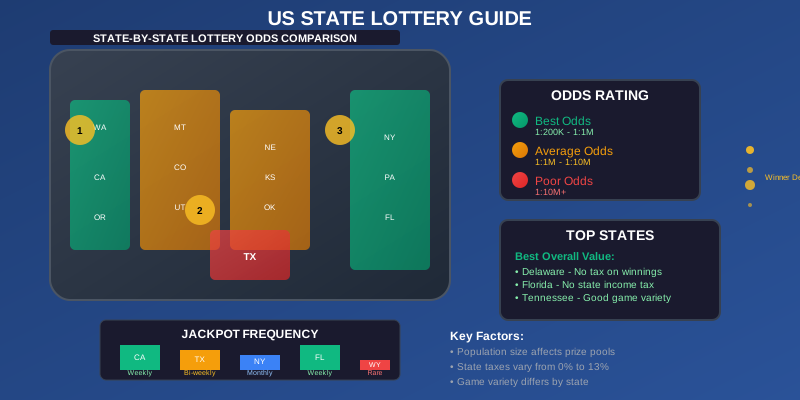
Not all state lotteries are created equal. From tax rates to game variety, odds to prize structures, where you play can significantly impact your potential returns. This comprehensive guide analyzes lottery opportunities across all 50 states to help you make informed decisions.
The Big Picture: State Lottery Landscape
Currently, 45 states plus Washington D.C., Puerto Rico, and the U.S. Virgin Islands operate lotteries. Five states do not have lotteries:
States Without Lotteries:
- Alabama: Constitutional prohibition, though legislation has been proposed
- Alaska: No state lottery, but residents can play Powerball and Mega Millions online
- Hawaii: Gambling is largely prohibited by state constitution
- Nevada: Casino industry opposition, though multi-state games are legal
- Utah: Constitutional ban on all forms of gambling
Tax Considerations: The Hidden Factor
State taxes on lottery winnings vary dramatically and can significantly impact your actual payout:
| Tax Category | States | Rate |
|---|---|---|
| No State Tax | Delaware, Florida, New Hampshire, South Dakota, Tennessee, Texas, Washington, Wyoming | 0% |
| Low Tax States | North Dakota (2.9%), Pennsylvania (3.07%), Indiana (3.23%) | 2.9% - 3.23% |
| Moderate Tax States | Arizona (4.5%), Colorado (4.4%), Illinois (4.95%) | 4% - 6% |
| High Tax States | New York (8.82%), Maryland (8.95%), New Jersey (8%) | 7% - 13.3% |
Tax Strategy Tip:
If you're planning to move after a big win, consider timing and residency requirements. Some states tax based on where you bought the ticket, others on where you claim it.
Best Odds by State: Game Analysis
While Powerball and Mega Millions are available in most states, each state offers unique games with varying odds:
Top States for Better Odds:
Massachusetts
- • Mass Cash: 1 in 324,632
- • Numbers Game: 1 in 1,000
- • Excellent scratch-off variety
- • High overall return to players (73%)
Texas
- • Texas Two Step: 1 in 1,832,600
- • Cash Five: 1 in 324,632
- • Daily 4: 1 in 10,000
- • No state income tax
Florida
- • Fantasy 5: 1 in 376,992
- • Play 4: 1 in 10,000
- • Cash 3: 1 in 1,000
- • No state income tax
California
- • SuperLotto Plus: 1 in 41,416,353
- • Fantasy 5: 1 in 575,757
- • Daily 4: 1 in 10,000
- • Largest lottery market
State-Specific Strategies:
Small State Advantage
States like Wyoming, Delaware, and Vermont often have smaller lottery pools, meaning better odds for state-specific games, though prize amounts may be lower.
Large State Benefits
California, Texas, and New York offer the largest prize pools and most game variety, but competition is fierce and taxes can be high.
Multi-State Game Participation
Understanding which states participate in major multi-state games can help with strategy:
Powerball (45 states + DC, PR, VI)
Not available in: Alabama, Alaska, Hawaii, Nevada, Utah
Starting jackpot: $20 million, Odds: 1 in 292.2 million
Mega Millions (45 states + DC, VI)
Not available in: Alabama, Alaska, Hawaii, Nevada, Utah
Starting jackpot: $20 million, Odds: 1 in 302.6 million
Regional Lottery Insights
Northeast: High Taxes, High Volume
States like New York, Massachusetts, and Connecticut have some of the highest lottery sales per capita but also steep tax rates. Massachusetts leads in innovation with unique game formats.
South: Tax-Friendly Territory
Florida, Texas, and Tennessee offer tax advantages for winners. Florida's lottery is particularly well-managed with consistent revenue generation for education.
West: Innovation Leaders
California pioneered many modern lottery features, while smaller western states often offer better odds on local games due to smaller populations.
Midwest: Balanced Approach
States like Ohio, Michigan, and Illinois offer moderate tax rates and good game variety, making them solid middle-ground options.
Scratch-Off Strategy by State
Scratch-off games vary significantly by state in terms of odds, prizes, and return rates:
| State | Return Rate | Best Features |
|---|---|---|
| Massachusetts | ~73% | High-value games, frequent new releases |
| Texas | ~70% | Large variety, no state tax on winnings |
| Florida | ~68% | Consistent releases, no state tax |
| New York | ~65% | High-value top prizes, but heavy taxation |
Key Factors for State Selection
Advantages to Consider:
- State tax rates on winnings
- Game variety and odds
- Prize claim procedures
- Anonymity laws
- Second-chance drawings
- Return-to-player rates
Potential Drawbacks:
- High tax rates
- Limited game options
- Poor odds on local games
- Mandatory publicity for winners
- Complex claim procedures
- Low return rates
Winner Anonymity by State
Privacy protection varies significantly across states:
Full Anonymity Allowed:
Delaware, Kansas, Maryland, North Dakota, Ohio, South Carolina, Texas, West Virginia, Wyoming
Limited Anonymity:
Some states allow anonymity for certain prize amounts or through trust structures. Check specific state regulations.
No Anonymity:
Most other states require winner disclosure as part of transparency laws, though some allow delays or limited information.
Future Trends and Considerations
The lottery landscape continues evolving:
- Online Sales: More states are moving to digital platforms
- Mobile Apps: Enhanced user experience and engagement
- Cryptocurrency: Some states exploring digital payment options
- Interstate Cooperation: More multi-state games being developed
- Responsible Gaming: Increased focus on player protection measures
Final Recommendations
Strategic State Selection Framework:
- Tax Optimization: Prioritize states with no or low lottery taxes
- Game Analysis: Focus on games with better odds-to-prize ratios
- Privacy Needs: Consider anonymity laws if privacy is important
- Local Opportunities: Don't overlook state-specific games with better odds
- Volume Strategy: Balance between better odds and larger prize pools
Remember, no strategy guarantees lottery success, but understanding state-by-state differences can help you make more informed decisions about where and how to play.
Always play responsibly and within your means. This analysis is for informational purposes and should not be considered as guaranteed financial advice.
Related Articles
Understanding Lottery Odds: A Mathematical Deep Dive
Master the mathematics behind lottery odds and improve your understanding of probability...
Frequency Analysis in Modern Lottery Strategy
Explore how historical data analysis can inform better lottery number selection strategies...